GeM Seller Certifications 2026: Compliance Checklist
What Certifications Do GeM Sellers Need in 2026? Complete Compliance Checklist
After 8+ years of helping sellers on GeM, the most common question we hear is: "Which certificates do I actually need?" It usually comes up right after registration, when a category demands a test report, a bid asks for ISO, or a buyer adds BIFMA or RoHS in the ATC.
The answer: there's no fixed list for everyone. GeM compliance depends on what you sell, where you list it, and what each bid requires. This guide covers the 11 registrations and certifications that matter most in 2026 and helps you work out which ones apply to you.
What Are Certifications Mandatory for Every GeM Seller?
No. Every GeM seller does not need every certificate. Only a few basics — like valid business and tax details — apply to almost everyone. The rest depend on your product category, your service type, the GeM category specifications, and the conditions written inside each bid document.
Think of it in three buckets:
-
Mandatory by law — for example, a food business needs food licensing to operate at all, whether or not GeM exists.
-
May be required — a certificate that becomes necessary because your product category or a specific tender demands it.
-
Optional / business choice — a certificate you take for credibility, exports, or brand protection.
Before spending money on a certification, check whether your category or tender actually requires it. This requirement may vary depending on the product, category, buyer and tender conditions.
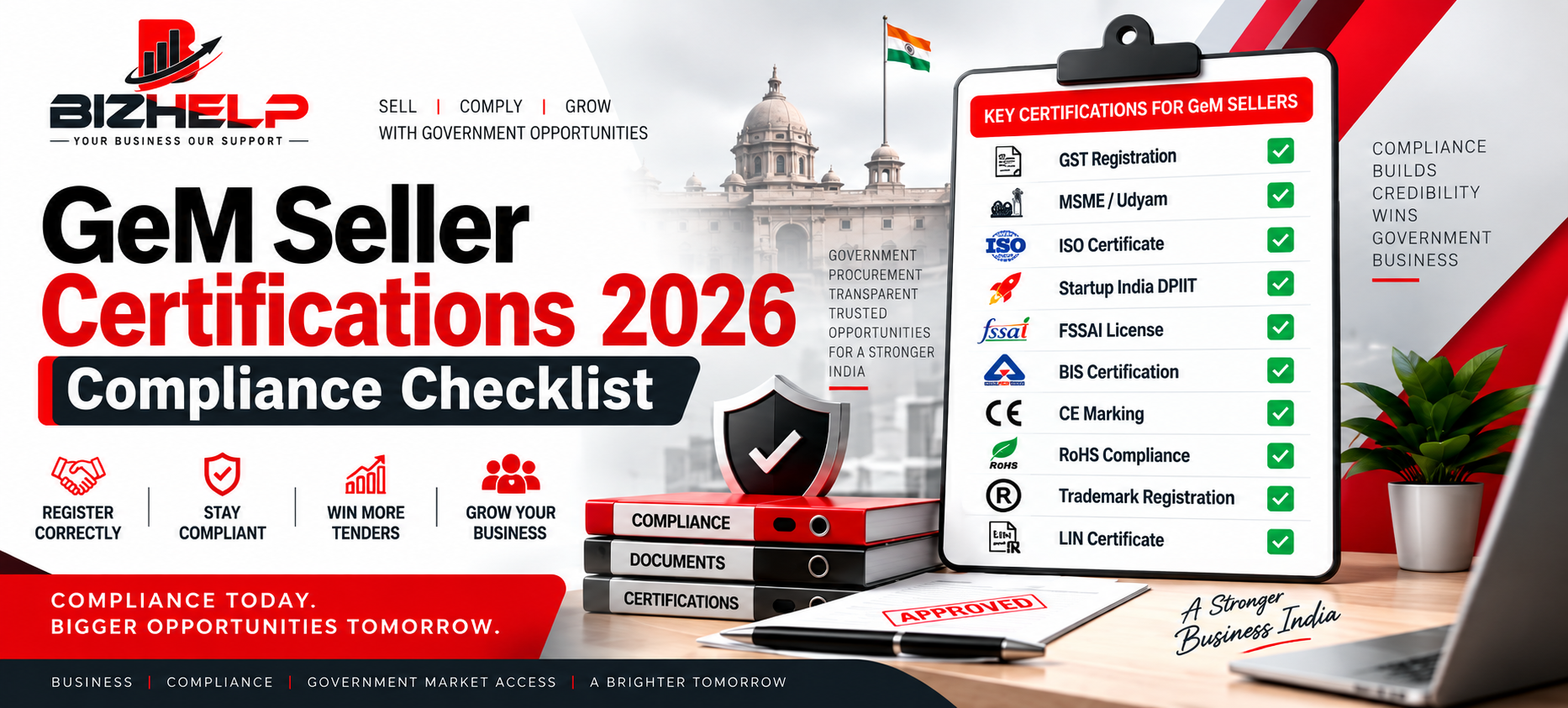
GeM Seller Compliance Checklist 2026
This table covers the eleven GeM seller certification and registration items that come up most often. Read the last column carefully — that is where sellers usually waste money.
|
Certification / Registration |
What Is It? |
Who May Need It? |
Is It Always Mandatory on GeM? |
|
GST Registration |
Tax registration for supplying goods/services |
Most sellers raising tax invoices to government buyers |
Commonly required; depends on your tax position and category |
|
MSME Udyam Registration |
Official MSME identity from Government of India |
Micro, small and medium enterprises |
No — voluntary registration |
|
Startup India DPIIT |
Official startup recognition by DPIIT |
Eligible new entities working on innovation |
No |
|
ISO Certification |
Management-system standard (quality, security, etc.) |
Businesses whose tenders ask for a specific ISO standard |
No — tender-dependent |
|
BIS Certification |
Indian product standards certification |
Makers/importers of notified regulated products |
Only where the product falls under applicable BIS requirements |
|
FSSAI License |
Food business licence/registration |
Food manufacturers, packers, suppliers |
Only for food-related businesses |
|
BIFMA Certification |
Furniture performance and safety testing standards |
Office and institutional furniture suppliers |
No — depends on tender specifications |
|
RoHS Compliance |
Restriction of hazardous substances in electronics |
Electrical and electronic product suppliers |
No — product and tender dependent |
|
CE Marking |
Conformity marking used for the European market |
Exporters; some products where a buyer specifies it |
No — not an Indian requirement |
|
Trademark Registration |
Legal protection of your brand name or logo |
Brand owners and OEMs |
No — but often useful for brand and OEM matters |
|
LIN Certificate |
Labour Identification Number for labour-law filings |
Establishments covered by labour-law compliance |
No — applicability-based |
1. GST Registration
GST registration gives your business a GSTIN — a tax identity number used on every invoice. Government buyers pay against proper tax invoices, so your GST details need to be correct and live on your seller profile.
Two things matter more than people realise. The legal name, PAN and address on GST must match your GeM profile exactly — mismatches cause rejections at order and payment stage. And tax treatment can differ between goods and services, so confirm the correct rate and HSN/SAC for what you actually supply.
2. MSME Udyam Registration
MSME Udyam registration is the government's official record that your business is a micro, small or medium enterprise. It is free, online, and based on your investment and turnover figures.
Many sellers take it because public procurement policies include provisions for micro and small enterprises. Whether a particular relaxation or preference applies to a specific bid depends on the policy in force and what that bid document states. Udyam registration by itself does not guarantee an exemption or an order.
3. Startup India DPIIT Recognition
Startup India DPIIT recognition is different from simply being a newly incorporated company. It is a formal recognition granted by the Department for Promotion of Industry and Internal Trade to entities that meet its eligibility conditions.
Here is where many sellers get confused: DPIIT recognition does not automatically unlock every tender relaxation. Any benefit is governed by the applicable scheme conditions and by what the individual bid allows.
4. ISO Certification
ISO certification means an independent body has audited your business against an international management standard and found your system in order. It certifies how you run the business, not the product itself.
Different tenders ask for different standards: ISO 9001 (quality management), ISO 14001 (environmental), ISO 45001 (occupational health and safety), ISO 27001 (information security). An IT services bid may ask for 27001; a manufacturing bid may ask for 9001.
ISO is not compulsory for every GeM seller. If a bid does require it, take the exact standard that bid names. Businesses sometimes use an ISO certificate consultant to prepare documentation and coordinate the audit, but the certificate must come from a genuine accredited body — buyers do check.
5. BIS Certification
The Bureau of Indian Standards sets national standards for products in India. BIS certification is a product-level compliance requirement that may apply to certain regulated product categories.
This is the key distinction: GST and Udyam register your business; BIS certifies your product. Having one says nothing about the other.
For example, imagine you supply LED lighting or a small electrical appliance. Those product families can fall under applicable BIS requirements, and the category may ask for the certificate or a test report at listing stage. A stationery supplier faces nothing of the kind. Check the exact product and category requirement before you apply.
6. FSSAI License
FSSAI is the food safety authority in India. An FSSAI license or registration applies to businesses that manufacture, process, pack, store, distribute or sell food products — and this comes from food law, not from GeM.
A furniture seller does not need an FSSAI licence just because it sells on GeM. A supplier of packaged food, ration items or catering services does need the applicable licence or registration for its activity and scale, kept valid before bidding in any food category.
7. BIFMA Certification
BIFMA refers to furniture testing and performance standards used widely for office and institutional furniture — covering things like durability, stability and safety under repeated use.
BIFMA certification becomes relevant when a buyer specifies it. For example, imagine you sell office chairs to a government department. That department may require chairs tested to a named standard, with a lab test report attached to the bid.
This does not mean every furniture seller needs the same certificate. A school-bench tender and an executive-chair tender can ask for completely different test evidence.
8. RoHS Compliance
RoHS stands for Restriction of Hazardous Substances. In simple terms, it limits substances such as lead, mercury and cadmium in electrical and electronic products.
RoHS compliance most often appears for IT hardware, LED products, cables, batteries and electronic accessories, where a buyer may ask for a declaration or test report in the technical documents. Whether it applies to you is decided product-wise and tender-wise, not by a blanket rule for all electronics sellers.
9. CE Marking
CE marking is a conformity marking used for products placed on the European market. It indicates the manufacturer's declaration that the product meets the applicable European requirements.
It is not an Indian certification and should not be treated as a universal GeM requirement. It can appear in a technical specification where that standard is commonly referenced or imported equipment is involved. If a bid asks for it, verify the marking is genuine and that its scope covers the exact model you are quoting.
10. Trademark Registration
A trademark protects your brand name, logo or mark. Three things often get mixed up: company registration creates your legal entity, a brand name is what you call your product, and trademark registration is what gives you legal rights over that name or mark.
OEMs and brand owners find trademark documentation useful, because brand ownership comes up when authorising resellers or establishing OEM compliance on GeM. It is not automatically mandatory for every seller — a reseller quoting someone else's brand needs authorisation from that brand owner, not a trademark of their own.
11. LIN Certificate
LIN stands for Labour Identification Number — a single identification number used by establishments for labour-law filings with the labour authorities.
It comes up more often in manpower-heavy work such as housekeeping, security or construction services, where a bid may ask for labour-compliance documents. A LIN certificate is not a universal requirement for every GeM seller — applicability depends on your establishment and on what the bid asks for.
Product-Wise Certification Examples
|
Business / Product Type |
Possible Compliance to Check |
|
Food supplier |
GST, FSSAI, applicable product standards |
|
Furniture manufacturer |
GST, Udyam, ISO/BIFMA if applicable |
|
Electronics supplier |
BIS / RoHS / CE where applicable |
|
IT company |
GST, ISO standards depending on tender |
|
OEM / Manufacturer |
Product-specific licences and certifications |
|
Startup |
GST, Udyam, DPIIT where applicable |
|
General reseller |
Business registration + category/tender-specific documents |
These are examples, not a universal list of mandatory certificates.
GeM Compliance vs Government Tender Compliance
These are two different things, and mixing them up is the single most common source of confusion.
GeM compliance
Requirements tied to the platform itself — your seller profile details, your category and catalogue, the product or service specifications you list against, and the documents GeM asks for during onboarding or vendor assessment. This is business compliance India sellers handle once and then maintain.
Govt tender compliance
Requirements written inside one specific bid. These can include experience, turnover, OEM authorization, test reports, certifications, past performance, EMD, technical documents and undertakings. Govt tender compliance changes from bid to bid — two tenders for the same product can demand completely different paperwork.
Clearing GeM compliance lets you list and sell. Clearing tender compliance lets you win a particular bid.
How to Check Which Certification Your Business Actually Needs
-
Identify your exact product or service — model, variant and specification.
-
Find the relevant GeM category for it.
-
Read the category specifications in full.
-
Check the seller and OEM requirements for that category.
-
Open the actual tender or bid document.
-
Read the eligibility criteria.
-
Read the technical specifications line by line.
-
Read the Additional Terms and Conditions — buyers add requirements here.
-
Check applicable Indian regulatory requirements for your product or activity.
-
Obtain only relevant and authentic certifications from genuine authorities or accredited bodies.
-
Keep certificates valid, and keep records and renewals updated.
-
Verify everything once more immediately before submitting the bid.
Common Compliance Mistakes GeM Sellers Make
-
Assuming every certificate is compulsory. Most are conditional.
-
Buying irrelevant certificates. Money spent on a standard nobody asked for.
-
Using expired certificates. Validity is checked at bid evaluation, not at purchase.
-
Submitting certificates for the wrong entity. A certificate in the proprietor's other firm does not cover this firm.
-
Business name mismatch. Small differences in spelling or suffix cause rejection.
-
GST, PAN and company-name mismatch across documents and the GeM profile.
-
Ignoring product-specific requirements such as applicable BIS norms.
-
Missing test reports. Many bids want the report, not just the certificate.
-
Ignoring buyer-added conditions hidden in the ATC.
-
Relying on an old tender. Last year's document list is not this bid's list.
-
Uploading unclear or incomplete scans.
-
Using a certificate whose scope does not cover the product or service being quoted.
Quick GeM Seller Compliance Checklist
☐ PAN and business details correct
☐ GST details checked and matching
☐ Udyam status checked
☐ DPIIT recognition checked if applicable
☐ Required ISO standard checked against the bid
☐ BIS applicability checked for the product
☐ FSSAI checked for food products
☐ BIFMA or furniture test requirements checked
☐ RoHS requirements checked
☐ CE requirement checked
☐ Trademark / brand documents checked
☐ OEM authorization checked
☐ Product test reports arranged
☐ Tender ATC reviewed
☐ Certificate validity checked
☐ Business name matches across all documents
Frequently Asked Questions
Q. What certifications are required for GeM sellers?
Ans. There is no fixed universal list. Most sellers need correct business and GST details, and then certifications depend on the product category and the bid. Food needs FSSAI, notified electrical products may need BIS, furniture bids may ask for BIFMA-related testing. Always check your GeM category specification and the tender document.
Q. Is ISO certification mandatory for GeM sellers?
Ans. No. ISO is not mandatory for every GeM seller. It becomes necessary when a specific bid or category asks for a specific standard, such as ISO 9001 for quality management or ISO 27001 for information security. Take the standard the bid names, from an accredited certification body.
Q. Is BIS certification mandatory on GeM?
Ans. Not for all sellers. BIS certification is product-based and applies where your product falls under applicable BIS requirements. A supplier of notified electrical goods may need it; a stationery supplier usually will not. Confirm against the exact product and category requirement.
Q. Do I need GST registration to sell on GeM?
Ans. In most cases yes, because government buyers transact against tax invoices. Some low-turnover or exempt situations exist under GST law. Whatever your position, keep your GST legal name, PAN and address matching your GeM profile exactly to avoid order and payment problems.
Q. Is MSME Udyam registration mandatory for GeM?
Ans. No. Udyam registration is voluntary. Many small sellers take it because public procurement policies contain provisions for micro and small enterprises, but any benefit in a given bid depends on the applicable policy and that bid's conditions. It does not guarantee eligibility or an order.
Q. Is Startup India DPIIT registration required for GeM?
Ans. No. DPIIT recognition is optional and only for entities meeting its eligibility conditions. It is separate from simply being a newly registered company. Any relaxation for recognised startups depends on the scheme conditions in force and on what the individual tender permits.
Q. Does a GeM seller need a trademark?
Ans. Not automatically. A trademark protects your own brand name or logo, so it matters most to OEMs and brand owners. A reseller selling another company's brand needs authorisation from that brand owner instead. Check what your category or bid actually asks for before filing.
Q. When is FSSAI required on GeM?
Ans. When your business deals in food — manufacturing, processing, packing, storing, distributing or supplying food products, including catering and ration supply. This comes from food safety law, not from GeM. A non-food seller does not need it simply because they sell on the portal.
Q. Is BIFMA certification mandatory for furniture sellers?
Ans. No, not as a blanket rule. BIFMA-related requirements appear where a buyer specifies particular performance, safety or testing standards for the furniture being procured. Two furniture tenders can ask for entirely different test evidence, so read the technical specification of each bid.
Q. What is the difference between GeM compliance and govt tender compliance?
Ans. GeM compliance covers the platform side — your seller profile, category, catalogue and product specifications. Govt tender compliance covers what one particular bid demands: experience, turnover, OEM authorization, test reports, certificates, EMD and undertakings. The first lets you sell; the second lets you win a specific bid.
Q. How do I know which certificate is required for my product?
Ans. Start with your exact product, find its GeM category, and read the category specification. Then open the live bid and read the eligibility criteria, technical specifications and Additional Terms and Conditions. Whatever is listed there is your answer for that bid. Requirements change, so verify each time.
How BizHelp Helps You Get the Right Certification
Most sellers do not need help filling a form. They need someone to tell them which certificate to take and which one to skip — and then handle the paperwork so it does not sit half-done for three months.
That is where BizHelp comes in. With 8+ years of working only on GeM and government tenders, we look at your category and your live bids first, then recommend compliance.
Our process
-
Free consultation. Tell us your product or service and your GeM category. We check what that category and your target tenders actually ask for.
-
Exact document checklist. You get a written list of what applies to you — and, just as usefully, what does not.
-
Application and filing. Our team prepares the file and applies to the correct authority or accredited body on your behalf.
-
Follow-up and objections. We track the application, respond to queries and objections, and keep you updated.
-
Certificate delivered. You receive it digitally, ready to attach to your GeM profile or bid.
What we handle
GST registration, MSME Udyam registration, Startup India DPIIT recognition, ISO certification, BIS certification, FSSAI license, BIFMA certification, RoHS compliance, CE marking, trademark registration and LIN certificate — plus the GeM-side work around them: seller profile correction, catalogue and category issues, OEM authorization and vendor assessment.
One point of contact instead of five consultants. Timelines depend on the issuing authority, and no consultant can promise tender eligibility or a win — what we can do is make sure the documents you hold are relevant, authentic, valid and correctly matched to your business name and PAN.
Not sure what applies to you?
Send us your product name and GeM category on WhatsApp at +91 93102 69560 and we will tell you what to check first — talk to a compliance expert.
The Practical Takeaway
There is no single certification checklist that applies equally to every GeM seller. The right compliance for you depends on your business, your product or service, your GeM category, the regulations that apply to your industry, and the conditions of the individual tender in front of you.
Rules and category requirements change, so verify the latest position on the official portals and in the current bid document rather than relying on an old list. Work in that order — product, category, tender, then certificate — and you will spend money only on documents that help you sell. Collecting certificates first and looking for a use afterwards is how sellers end up with an expensive file and no orders.
Related Blogs & Insights